
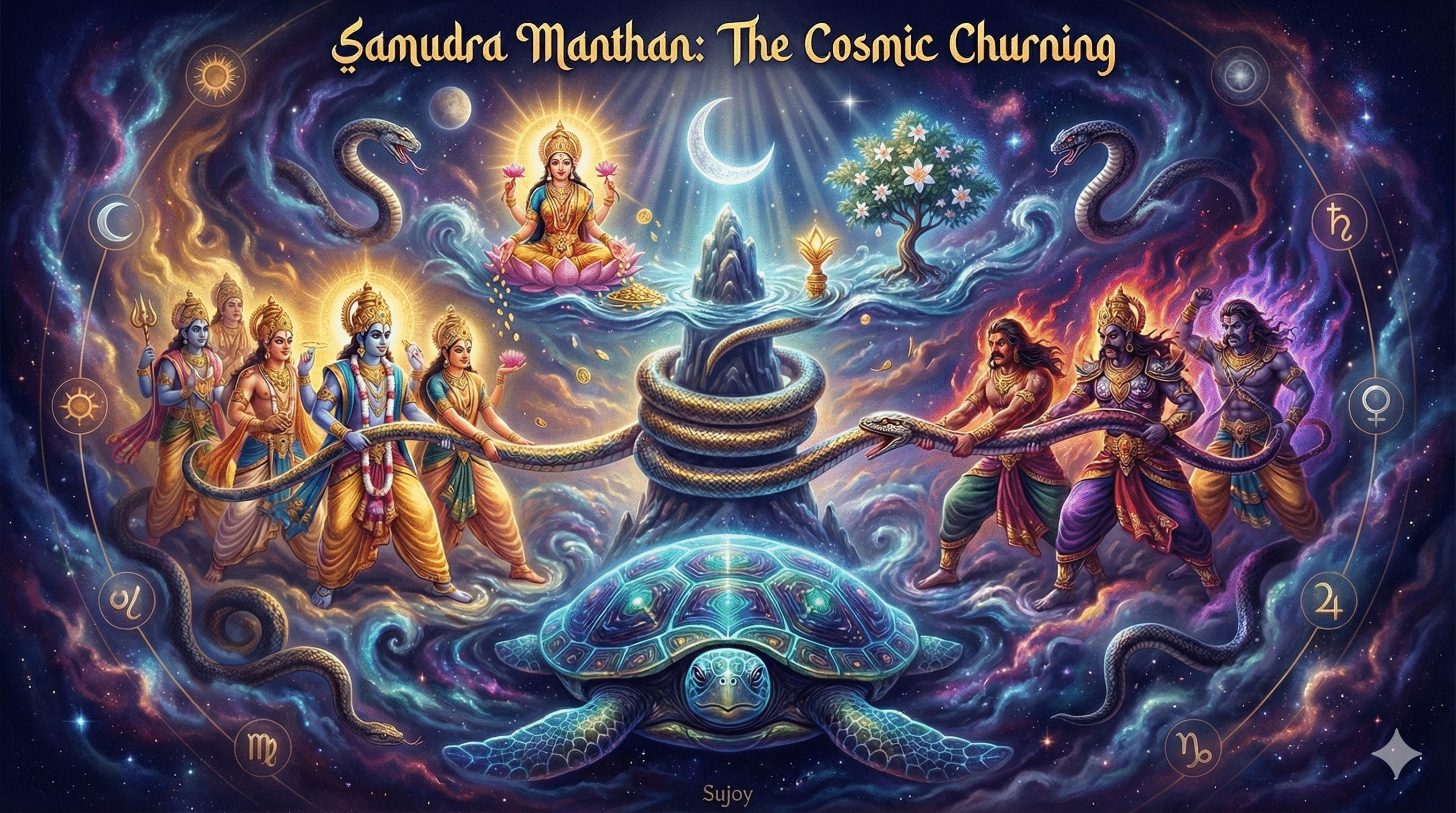
The Samudra Manthan Leela: When Cosmic Mythology Meets Vedic Astrology
The Samudra Manthan, or the Churning of the Cosmic Ocean, stands as one of Hindu mythology’s most profound narratives. Yet beyond its surface as a dramatic tale of gods and demons, this ancient leela holds deeper significance for those studying Vedic astrology. It is not merely a story of immortality sought, but rather a cosmic blueprint for understanding how we navigate the eternal dance of opposing forces within our own birth charts and life journey.
The Foundation: Understanding the Samudra Manthan
Before diving into astrological connections, let’s anchor ourselves in the story itself. When the Devas faced depletion after a curse from sage Durvasa, they approached Lord Vishnu seeking wisdom. Vishnu revealed that only through cooperation with the Asuras—the very forces opposing them—could they churn the cosmic ocean and extract amrita, the nectar of immortality.
What follows is a carefully orchestrated cosmic event. The Devas and Asuras used Mount Mandara as the churning rod and the serpent Vasuki as the churning rope. Lord Vishnu, manifesting as the Kurma avatar (the tortoise), supported the mountain’s weight beneath the ocean’s depths. As the churning commenced, numerous treasures emerged: the wish-granting Kalpavriksha, the divine cow Kamadhenu, Lakshmi the goddess of prosperity, and the celestial Chandra (the Moon).
Yet before these blessings came Halahala—a deadly poison capable of annihilating all existence. It was Lord Shiva’s supreme sacrifice that saved the cosmos, as he consumed the poison and held it in his throat, earning the name Neelkantha (the blue-throated one). Finally, when the amrita appeared, Lord Vishnu assumed the mesmerizing form of Mohini to ensure the nectar reached the worthy Devas, embodying the principle of divine discrimination and strategic wisdom.
The Astrological Lens: Karmic Churning and Planetary Forces
This is where the narrative transforms into something deeply relevant for modern astrologers and Vedic practitioners. The Samudra Manthan, when viewed through the lens of Vedic astrology, becomes less a historical myth and more an eternal principle playing out within every horoscope and every human lifetime.
The Ocean as the Unconscious Mind
In yogic interpretation, the cosmic ocean represents our unconscious mind—that vast reservoir of potential, trauma, karma, and untapped wisdom. Just as the deities and demons churned the ocean to bring treasures and poison to the surface, we churn our own inner ocean through life’s experiences, transits, and spiritual practices. The movement we experience—the cycles of difficulty and ease—is nothing more than this sacred churning process.
When Saturn transits through your birth chart during periods like Sade Sati, or when Rahu and Ketu challenge your established ways, understand this: you are experiencing your own Samudra Manthan. The universe is churning your consciousness, bringing both poison and nectar to the surface of awareness.
Mount Mandara: The Stability of Mind
In the churning mythology, Mount Mandara represents the human mind itself—its stability, determination, and capacity for focused intention. The mountain does not move easily; it requires both effort and divine support. This is precisely how our minds must function during difficult astrological periods. We must become like Mount Mandara—immovable in our principle, steady in our resolve, yet flexible enough to allow the churning process to work through us.
Vasuki the Serpent: Desires as Divine Tools
The great serpent Vasuki, wound around Mount Mandara as the churning rope, represents desire itself. In most spiritual traditions, desire is portrayed as an impediment. Yet the Samudra Manthan teaches us something far more nuanced: desires, when properly directed and controlled, become instruments of divine work. They provide the friction necessary for the churning to occur.
In astrological terms, this speaks to how Venus (the planet of desire) and Mars (the planet of drive) function in our charts. Rather than suppressing these energies, the mythology suggests we harness them purposefully. The Asuras held the head of Vasuki while the Devas held the tail—both needed the serpent’s power to produce results.
The Shadow Planets: Rahu, Ketu, and the Paradox of Duality
Perhaps the most astrologingly fascinating element of the Samudra Manthan is the birth of Rahu and Ketu—the shadow planets that define our karmic trajectory.
When the amrita emerged and Dhanvantari distributed it, the demon Svarbhanu disguised himself among the Devas to consume the nectar. Surya and Chandra (the Sun and Moon) detected the deception. Lord Vishnu’s Sudarshan Chakra severed Svarbhanu’s head from his body before the nectar could be fully assimilated, but because he had begun drinking it, neither part could be destroyed. The head became Rahu, and the body became Ketu—the eternal symbol of karmic nodes.
This is profound: Rahu and Ketu exist because of an attempt to cheat the system, to gain immortality through deception rather than through earned merit. In Vedic astrology, these nodes carry similar themes. Rahu represents our karmic hunger—the areas of life where we feel incomplete and endlessly pursue solutions. Ketu represents what we already have mastery over but must learn to release.
The transits of these nodes through your birth chart are nothing less than the universe orchestrating your own Samudra Manthan. Where Rahu touches, we must churn the depths of ambition and obsession until we extract genuine wisdom. Where Ketu touches, we must release attachment to false security.
The Birth of Treasures: Planetary Meanings in the Churning
What emerged from the ocean directly reflects the planetary principles in Vedic astrology:
Lakshmi—The Feminine Principle of Venus: The goddess of wealth, prosperity, and abundance chose Vishnu as her eternal consort. Venus in astrology similarly represents not just material wealth but the magnetic power of divine grace. When well-placed in a chart, Venus grants prosperity. When afflicted, it creates cycles of loss—both literal and symbolic.
Chandra—The Moon Adorned by Shiva: The Moon emerged as one of the greatest treasures, and it was Lord Shiva himself who wore it in his hair. The Moon governs the mind, emotions, and psychological stability. In a sense, Shiva adorning the Moon with his presence suggests that mental peace and emotional security come only through acceptance of both creative and destructive forces—the dual nature of Shiva himself.
The Parijata Tree—Jupiter’s Blessing: The wish-fulfilling tree that emerged from the churning represents Jupiter’s expansive, grace-bestowing nature. Jupiter in a birth chart functions as the dispenser of good fortune, provided we cultivate the soil of karma through right action.
Dhanvantari—Mercury’s Intelligence: The physician who emerged holding the pot of amrita represents the discriminative intellect—the mercurial capacity to distinguish poison from nectar, harm from benefit. Mercury’s placement in your chart determines your ability to communicate truth and navigate life’s complexities with wisdom.
The Poison: Understanding Saturn and Shadow Work
The emergence of Halahala before the treasures carries a truth that modern astrology often glosses over: purification precedes blessing. Before we can access the nectar, we must confront the poison. Before we can benefit from a positive transit, we often experience its shadow side first.
This is Saturn’s teaching. Saturn, associated with Lord Shiva’s role in consuming the poison, is not a malefic planet to be feared—it is a teacher administering necessary medicine. During Saturn’s transits, particularly Sade Sati, we face our deepest karmic debts, our hidden fears, and the consequences of past actions. Yet those who endure this churning with patience and discipline emerge with the kind of strength that no favorable transit alone can provide.
The poison held in Shiva’s throat—neither swallowed completely nor expelled—becomes the symbol of our shadow self: the parts of ourselves that are neither fully integrated nor fully rejected, but held in sacred tension. True Saturnian maturity involves recognizing and honoring this poison as part of our wholeness.
The Mohini Avatar: Discrimination and Wisdom
Perhaps the most subtle but essential astrological lesson comes from Vishnu’s Mohini avatar—the form he assumed to distribute the amrita with perfect discrimination. Mohini represents the power to see through illusion, to navigate complex social and psychological situations with grace, and to make choices aligned with dharma rather than short-term desire.
This is Jupiter’s highest expression. Jupiter governs wisdom, but Mohini shows that true wisdom isn’t merely intellectual knowledge—it is the capacity to act with perfect timing, exquisite discernment, and alignment with cosmic law. When Jupiter is well-aspected in a chart, it grants not just luck but the wisdom to use fortune righteously.
Living the Samudra Manthan: Practical Astrological Guidance
So what does it mean to live consciously with these teachings? How do we apply the Samudra Manthan to our birth charts and daily practice?
During Difficult Planetary Transits: Rather than viewing challenging periods—whether Saturn returns, Rahu/Ketu activations, or Mars afflictions—as purely negative, understand them as churning periods. These are times when life is deliberately stirring your unconscious to bring karmic material to the surface. Embrace rigorous spiritual practice, maintain discipline, and trust the process.
Invoking the Principle of Cooperation: The Devas and Asuras had to work together to churn the ocean. Astrologically, this means integrating opposing planetary energies within your chart rather than fighting them. If you have Mars and Saturn together, don’t suppress one for the other—learn to channel Mars’s drive through Saturn’s discipline. Transform the conflict into creative cooperation.
Seeking the Treasures: After every poison comes nectar. After every difficult transit comes opportunity. Train yourself to recognize the hidden blessings within challenges. What is the Lakshmi (prosperity), the Chandra (peace of mind), or the Parijata (wisdom) that this difficult period is trying to birth within you?
Cultivating Mohini’s Wisdom: Develop the capacity to discern between false desires and true needs, between what is genuinely beneficial and what merely appears so. This is the work of Jupiter and Mercury in your chart. Seek mentors, study philosophy, meditate on these distinctions.
The Eternal Churning
The beauty of the Samudra Manthan is that it is not a one-time event concluded in mythological time. Rather, it is the eternal dance of the cosmos—the perpetual churning that brings the universe into manifestation and dissolution, again and again. Within each of us, this churning continues through our birth chart, our transits, our choices, and our karmic evolution.
Every obstacle that appears is Halahala. Every blessing that emerges is nectar. Every moment of life is Mount Mandara rotating in the vast ocean of consciousness, supported by the Kurma avatar—the divine principle sustaining all existence. The question is not whether you will experience the churning, but whether you will meet it with the wisdom of the Devas, the courage of Shiva, and the discrimination of Mohini.
The Samudra Manthan teaches us that immortality—true lasting freedom and fulfillment—cannot be obtained passively. It requires effort, cooperation, sacrifice, wisdom, and patience. It requires churning through the mud before the lotus can bloom. And therein lies the deepest truth of Vedic astrology: your birth chart is not your limitation; it is the cosmic invitation to become divine through conscious participation in the eternal leela.

