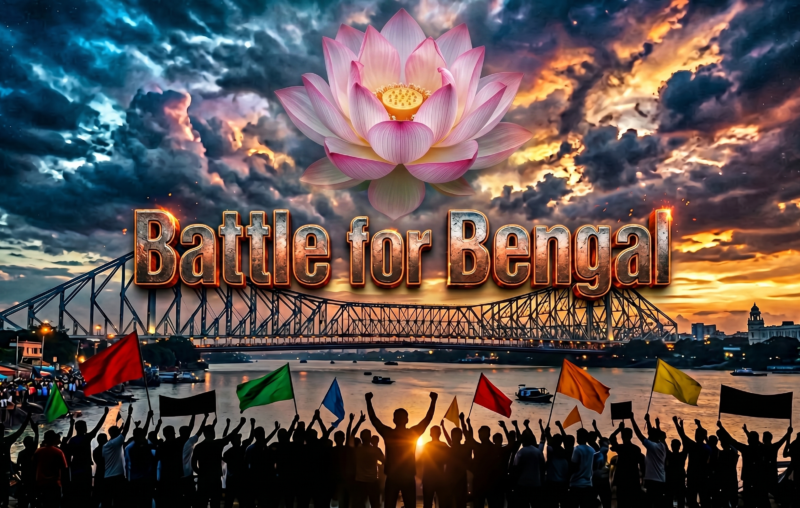
As a continuation to my earlier mundane astrology article https://www.vedicoracle.com/battle-for-bengal/ posted on March 18th I am detailing some further views on 2026 Bengal Assembly elections based on established principles of mundane astrology.
As per Dr. B.V Raman’s Avakhada based method for calculating the Ascendant for the Bengal region, he takes Gemini and also a part of Cancer as the ruling sign for the Bengal region.(One may refer Dr. Raman’s treatise , Prashnamarg for details). Planets controlling the theme of Bengal are Mercury the ruler of Gemini ( intellect), Moon(art, literature and culture) and Jupiter( beacon of knowledge).
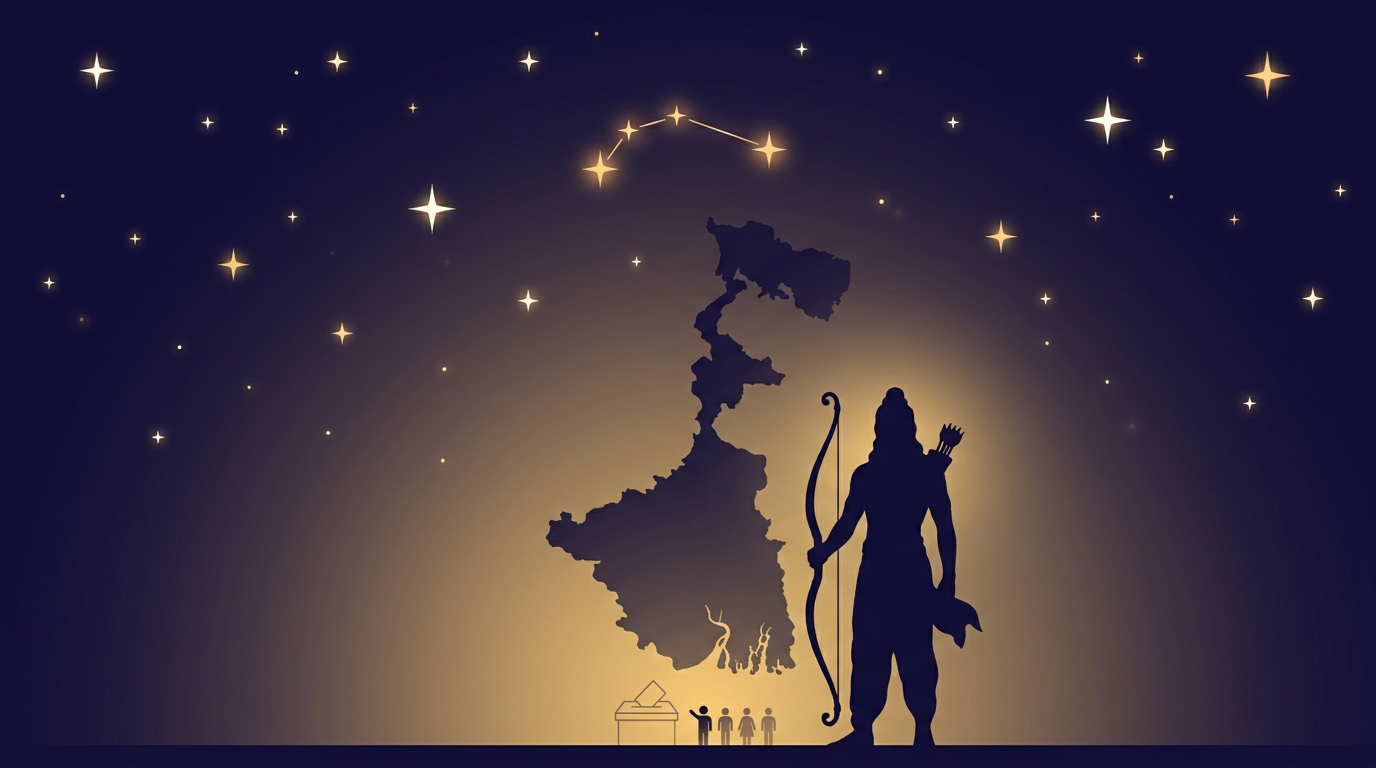
Classical texts and modern commentators agree that Lord Rama was born when the Moon was in Punarvasu Nakshatra, with Cancer rising, on Chaitra Shukla Navami. Punarvasu spans from 20° Gemini to 3°20′ Cancer and is ruled by Jupiter, with Aditi as the presiding deity, symbolising “return of the light”, restoration, and getting back what was lost.Many traditional and modern sources explicitly call Punarvasu the birth star of Lord Rama, and even describe the Ramayana verse that notes ,the Moon and Jupiter together in Cancer with Punarvasu rising at his birth. Because of this, Punarvasu is remembered as “ Lord Ram’s Nakshatra” ,a field where ideals of maryada, patience, and gentle but firm dharma are activated. Punarvasu literally comes from “Punar + Vasu” – meaning return, renewal, restoration, or being good again.
It’s symbols are a bow with a quiver of arrows and sometimes a home or dwelling, indicating readiness, protection, and the capacity to “come back home” after trials. The deity Aditi is the universal mother who restores what has been taken away, linking Punarvasu strongly with nourishment, forgiveness, and healing .Jupiter’s on going transit through Punarvasu from 13th August 2025 to 2nd June 2026 is unusually long , about ten months because of forward and retrograde motion within this single nakshatra. This prolonged stay allows Jupiter to“work deeply on the mind, perceptions and emotions, intensifying themes of renewal, moral debate, and ideological shifts.At the same time, the official schedule for the West Bengal Legislative Assembly election fixes the polling in two phases on 23 April and 29 April 2026, with counting on 4 May 2026. This means the entire Bengal election campaign, voting, and result declaration will take place under Jupiter’s stay in Punarvasu, the birth star of Shri Ram.For a mundane astrologer, this overlap is very significant: the Guru of dharma is revisiting Ram’s own nakshatra precisely as voters in a culturally intense state like Bengal decide on “who should rule” and “what kind of maryada or political ethos they want”.
Transit tables show that Jupiter moved into Punarvasu Nakshatra on 1 September 2013 in Gemini, later covering all three padas in Gemini and the Cancer pada through mid‑2014. During this period, India saw the collapse of the UPA‑II narrative amid corruption scandals and popular frustration, and the build‑up to the 2014 general election.
The 2014 Lok Sabha polls, held from 7 April to 12 May 2014, produced a historic mandate: the BJP under Narendra Modi won 282 seats and the NDA 336, bringing a clear single‑party majority to the Centre for the first time in three decades. Analysts widely describe 2014 as an election of “change” and “the election that changed India”, marked by a desire for better governance, strong leadership, and a new development‑plus‑nationalism narrative.Notice the Punarvasu themes here: the public demanded restoration of faith in institutions, renewal of economic hope, and a “return of strength” after a feeling of drift and scandal fatigue. Astrologers studying that Jupiter transit in Gemini for India’s chart also noted that it would weaken Congress and strengthen BJP, and could bring a new senior leader or change at the top ,which is exactly what unfolded in 2014.
Transit data shows Jupiter entering Punarvasu in Gemini around 30 September 2001, then turning retrograde within this nakshatra from early November 2001, before backing into Ardra again. This window coincided with a critical shift in Gujarat politics and the Hindutva narrative nationwide.In October 2001, Narendra Modi was brought in as Chief Minister of Gujarat, replacing Keshubhai Patel, as the BJP tried to stabilise its government and re‑energise its support base after a period of dissatisfaction. Over the next year, Gujarat went through the 2002 riots and then the December 2002 state elections, where the BJP won a strong majority, consolidating Modi’s leadership and embedding the Ram‑temple and Hindutva narrative much more firmly in mainstream politics.
Because Lord Rama himself is described as having Cancer Lagna with Moon in Punarvasu, and with a powerful alignment of exalted or strong planets, every major transit of Jupiter through Punarvasu can be seen as Guru visiting the subtle field of Shri Ram’s birth chart. Each such visit tends to reopen questions of raj‑dharma:
Are rulers behaving with maryada and transparency?
Are the weak and marginalised being protected?
Is there too much arrogance, or is there humility and service. When this happens over a politically charged state like West Bengal, the Shri Ram symbolism is likely to be used by different sides in different ways, some may invoke Shri Ram to justify strong‑handed order, others to demand justice for the oppressed, and still others to call for unity across communities. Punarvasu does not prefer one party or ideology; it prefers sincerity, restoration of balance, and returning to the essence after the excesses of the previous cycle (Ardra’s storms and tears).
If we read the pattern of earlier Jupiter‑Punarvasu cycles in 2001–02 and 2013–14, Indian politics tends to witness major corrections and new beginnings when Guru walks through Shri Ram’s nakshatra. With Bengal voting under the same sky pattern in April 2026, the message of the heavens seems clear, the time has come for Bengal to redefine its idea of dharma, leadership, and cultural identity and Shri Ram’s star will be quietly watching over that choice.