Imagine two people born on the same calendar date—say, March 15th. By Western numerology standards, their “life path number” would be identical. Both reduce to the same single digit. Their numerological destiny, according to conventional systems, would appear nearly the same.
But here’s the secret that Vedic wisdom has known for thousands of years: these two people’s lives might unfold in fundamentally different ways—not because of their birth date, but because of which lunar mansion their Moon was traveling through on the day they were born.
This is where 27-based numerology transcends the limitations of Western nine-number systems. This is where the ancient tradition of the Nakshatras reveals a hidden architecture of human destiny that Western numerology completely misses.
Why Western Numerology Falls Short
When you hear about numerology in mainstream contexts, it usually works like this: your birth date (say, March 15, 1995) gets reduced to a single digit. March (3) + 15 (1+5=6) + 1995 (1+9+9+5=24, then 2+4=6) = 3+6+6 = 15, which reduces to 6. Your “life path number” is 6. Millions of people worldwide are assigned the same life path number. Number 6 people are supposedly nurturing, family-oriented, responsible. Millions of 6s exist. How can this system capture individual uniqueness? It can’t. This is why countless people feel that generic numerology descriptions don’t quite fit their personality or life experience. The system collapses all complexity into nine categories. It’s like saying the entire ocean can be described as “water”—technically true, but useless for understanding tides, currents, and the living ecosystems beneath the surface. Why Western Numerology Falls Short The Vedic tradition solved this problem 5,000 years ago by introducing a 27-based system: the 27 Nakshatras, or lunar mansions.
What Are Nakshatras? The Vedic “Lunar Numbers”
In Sanskrit, Nakshatra means “that which does not decay”—an eternal cosmic marker that shapes human destiny. The 27 Nakshatras are lunar constellations that divide the zodiac into 27 equal sections, each spanning 13 degrees and 20 minutes of the celestial belt. Here’s the profound difference from Western systems: Nakshatras are not random categories —they’re based on the Moon’s actual movement through space. The Moon travels roughly 13 degrees and 20 minutes every 24 hours, visiting each Nakshatra in sequence. In approximately 27.3 days, the Moon completes a full cycle through all 27 lunar mansions. This isn’t abstract theory. It’s observable celestial mechanics. Each Nakshatra has: A ruling planet (its planetary lord) A presiding deity (the divine intelligence governing it) A unique symbol and set of characteristics A specific numerical vibration When you were born, the Moon was positioned in one of these 27 Nakshatras. That Nakshatra is your true “lunar number”—far more precise and nuanced than any life path number reduction.
The Flaw in Reducing to Nine: A Case Study
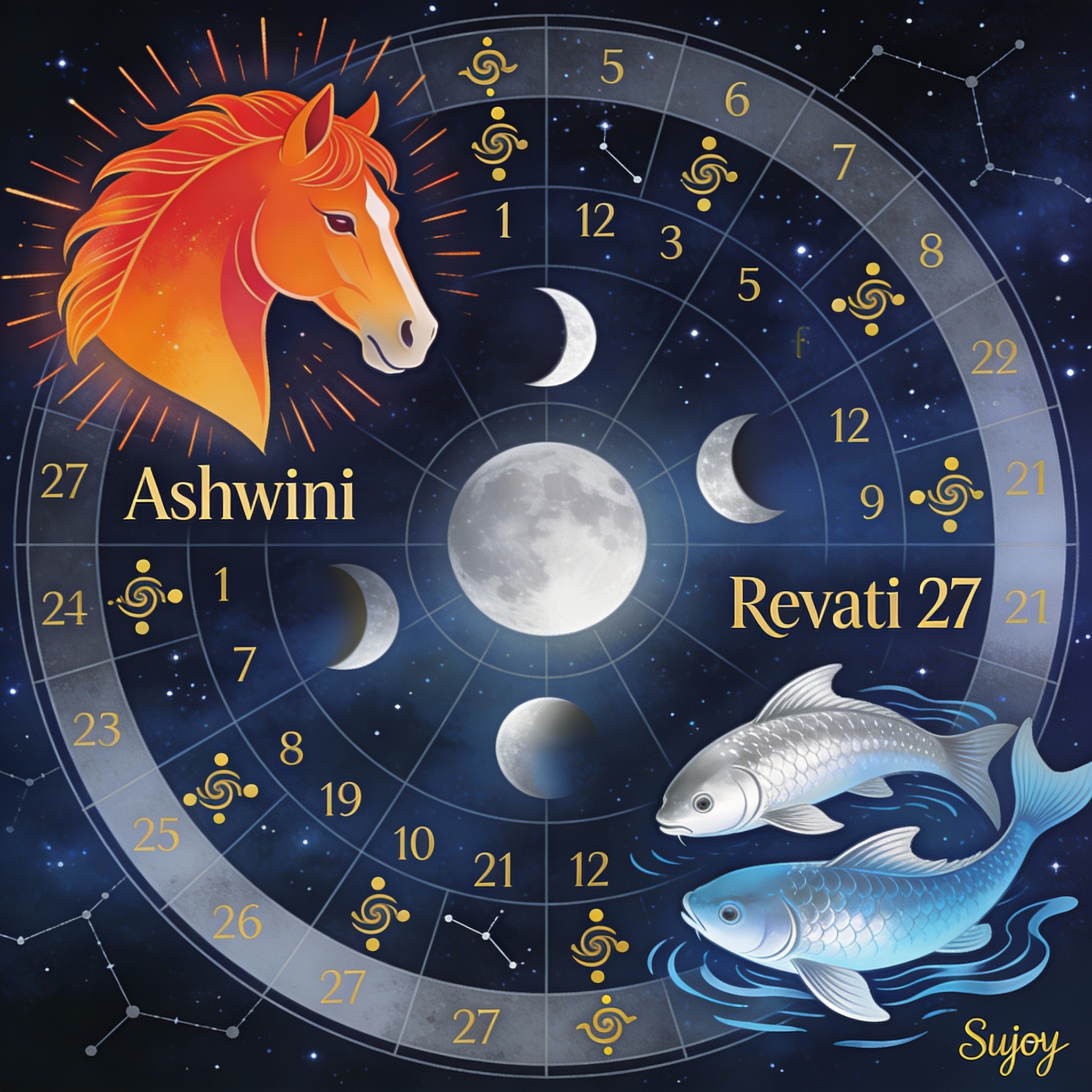
Let’s say Person A and Person B are both born on March 15th, giving them a life path number of 6. Person A has their Moon in Ashwini Nakshatra (Nakshatra 1). Person B has their Moon in Revati Nakshatra (Nakshatra 27). In a nine-number system, they’re the same. Reduce Ashwini (1) and Revati (27) to a single digit —both become numerologically insignificant (1+27=28, 2+8=10, 1+0=1, or simply 27 ÷ 9 = 3, remainder 0). They’re lumped together. But who are these people actually?
Ashwini: The Pioneer (Nakshatra 1)
Ashwini is symbolized by a horse’s head—not just any horse, but the swift, spirited mount of the Ashwini Kumaras, the divine twin healers in Hindu mythology.
Core Characteristics of Ashwini People: They possess an almost reckless pioneering energy. These are the people who start things—new projects, new relationships, new businesses. They ask questions first, think about consequences later. What Are Nakshatras? The Vedic “Lunar Numbers” The Flaw in Reducing to Nine: A Case Study Ashwini: The Pioneer (Nakshatra 1) [1] Ashwini natives have a natural gift for healing (inherited from their ruling deity). They’re drawn to medicine, therapy, wellness, sports medicine, veterinary work. If they’re not formally trained in healing, they often find themselves becoming the person friends call in crisis. Their mind operates in flashes. They see the big picture instantly but can miss details. Decisionmaking is quick—sometimes impulsive. They act, then analyze. This can be brilliant (they seize opportunities others hesitate over) or problematic (they leap before looking). They have diplomatic skills that don’t make sense with their aggressive energy—but Ashwini people are genuinely good at getting opposing parties to cooperate. The Ashwini Kumaras, after all, used their powers to heal conflicts in the divine realm. Ashwini people experience life as a series of fresh starts. They’re rarely satisfied with stability. Every few years, they reinvent themselves—new career, new city, new identity. Western numerology would call this instability. Vedic wisdom recognizes it as Ashwini’s true nature: the eternal pioneer. The numerical vibration of Ashwini is 1—the number of beginning, independence, leadership, and primal creative force.
Revati: The Nourisher (Nakshatra 27)
Revati sits at the opposite end of the spectrum—the 27th and final lunar mansion. Its symbol is two fish, and its ruling deity is Pushan, the divine protector and nourisher of all living beings.
Core Characteristics of Revati People: Unlike Ashwini’s aggressive pioneering, Revati natives are oriented toward completion, integration, and care. If Ashwini starts fires, Revati tends gardens. These are people who take responsibility for others—sometimes to the point of absorbing their problems. Revati people are deeply sensitive, perhaps overly so. They pick up on emotional currents in a room like radar. They’re naturally gifted at the arts, spirituality, mystical practices, and anything involving intuition. Many Revati natives become healers, counselors, artists, spiritual teachers. Where Ashwini is impulsive, Revati tends toward overthinking. Revati people can become paralyzed by awareness of too many possibilities and perspectives. They see how their actions affect others—sometimes this makes them generous; sometimes it makes them indecisive. Revati natives experience life as a continuous integration. They’re processing, synthesizing, trying to hold everything together. They struggle with boundaries because they’re genuinely concerned about the welfare of everyone around them. Where Ashwini asks “What do I want?”, Revati asks “What does everyone need?”The numerical vibration of Revati is 27, which reduces to 9 (2+7=9). In Vedic numerology, 9 represents completion, universality, and the fulfillment of a cycle. But this is crucial: Revati’s 27 is not the same as generic “9s” born under other Nakshatras. The 27 carries the specific signature of Pushan’s protective nourishment—it’s a 9 with spiritual and relational dimensions that pure numerology would miss.
The Same Birthday, Different Frequencies
Here’s where it gets extraordinary. Person A (Ashwini) and Person B (Revati), both born on March 15th, share the same calendar destiny. But: Ashwini Person navigates life by constantly pushing forward. Their career might involve multiple industries. Their relationships are passionate but sometimes brief. They’re the entrepreneur, the doctor, the healer who works in high-intensity environments. Revati Person navigates life by building depth. Their career might span decades in the same field or organization. Their relationships are few but profound. They’re the psychologist, the artist, the spiritual teacher who forms lasting bonds with those they guide. Both will experience their 30s differently. Both will face the same planetary transits differently. Both, when they reduce their birth date to a single number, appear identical on paper—but their actual experience of time, cycles, and change is profoundly different.
The 27-Based System: A Richer Architecture
The genius of the 27-Nakshatra system is that it reveals granular variation within broad categories. Consider: Western numerology has 9 categories. The Vedic Nakshatra system has 27 categories. Each Nakshatra also divides into 4 sub-sections (called padas), creating effectively 108 distinct combinations. This mirrors the structure of many sacred Vedic systems—108 names of Shiva, 108 beads on a mala, 108 Upanishads. The number 108 isn’t arbitrary; it reflects the Vedic understanding that reality requires 108 dimensions of consideration to be fully understood. Someone born in Ashwini’s first pada (sub-section) experiences different numerical cycles than someone born in Ashwini’s fourth pada, even though both are Ashwini natives. The first pada is ruled by Mars (courage, action, conflict); the fourth pada is ruled by Mercury (intellect, communication, calculation). Same Nakshatra, different frequencies. Similarly, Revati’s padas reflect different spiritual expressions: Revati’s 1st Pada (Sagittarius influence): Optimistic, generous, casual with boundaries Revati’s 2nd Pada (Capricorn influence): Organized, traditional, cautious Revati’s 3rd Pada (Aquarius influence): Compassionate, humanitarian, group-oriented Revati’s 4th Pada (Pisces influence): Spiritual, dreamy, highly intuitive This is numerology with real texture, not reduced to abstraction. The Same Birthday, Different Frequencies.
Numerical Cycles: How Ashwini and Revati Experience Time Differently
Here’s a practical way to understand how 27-based numerology transforms prediction: In Western numerology, a “Personal Year” number determines your themes for that calendar year. It’s calculated simply and resets annually. In Nakshatra-based numerology, your personal cycles align with the Moon’s actual movement through the Nakshatras. Your lunar cycle completes every 27.3 days—not 365 days. This means: An Ashwini person experiences their annual cycle much differently than a Revati person. Ashwini, ruled by Ketu (the shadow planet), experiences cycles of rapid change and release. A year for an Ashwini person might feel like three or four distinct chapters. They’re constantly cycling through new beginnings. A Revati person experiences their annual cycle with more continuity. Revati, ruled by Mercury (the planet of integration and communication), experiences years as long, unfolding narratives. A Revati person’s year is usually spent developing themes from the previous year. Ask an Ashwini person, “How was your year?” They’ll tell you about three different jobs, two moves, one profound healing crisis, and a complete identity shift. Ask a Revati person the same question. They’ll describe how this year deepened what last year started—deeper relationships, more refined artistic expression, greater spiritual understanding. Same calendar year. Completely different numerical experience.
Why Western Systems Ignore This
Western numerology evolved independently from Vedic systems. It developed its own rules and reductions. The nine-number system became standard because it was simple to calculate and remember before computers existed. The Vedic system wasn’t trying to be simple—it was trying to be accurate. It maps onto the actual movement of the Moon and ancient astronomical observation. It’s more complex, but it’s complex because reality is complex. In the last two decades, as Western spirituality has grown curious about Vedic systems, many practitioners have started integrating Nakshatras into their numerological practice. The most cutting-edge numerologists now use 27-based systems because they recognize that 9-number reduction discards too much information.
The Deeper Truth
Western numerology asks: “What number are you?” Vedic numerology asks: “Which eternal cosmic mansion is your soul anchored in? How does the Moon’s movement through 27 divine stations shape your consciousness?” These are completely different questions. The second is far more useful, far more accurate, and far more aligned with how the universe actually works. The next time someone tells you that all people with the same birth date share the same destiny, they will have to understand that Ashwini and Revati, though they may share the Why Western Systems Ignore This The Integration: How to Use 27-Based Numerology The Deeper Truth same calendar day, are living in completely different numerical universes—one of constant renewal, one of deepening integration. Both are equally valuable. Both are completely different. That’s the secret that numerology’s reduction to nine misses entirely. And it’s why the ancient Vedic sages chose 27.
– Sujoy Sikder. The author is a Vedic/Nadi Astrologer