
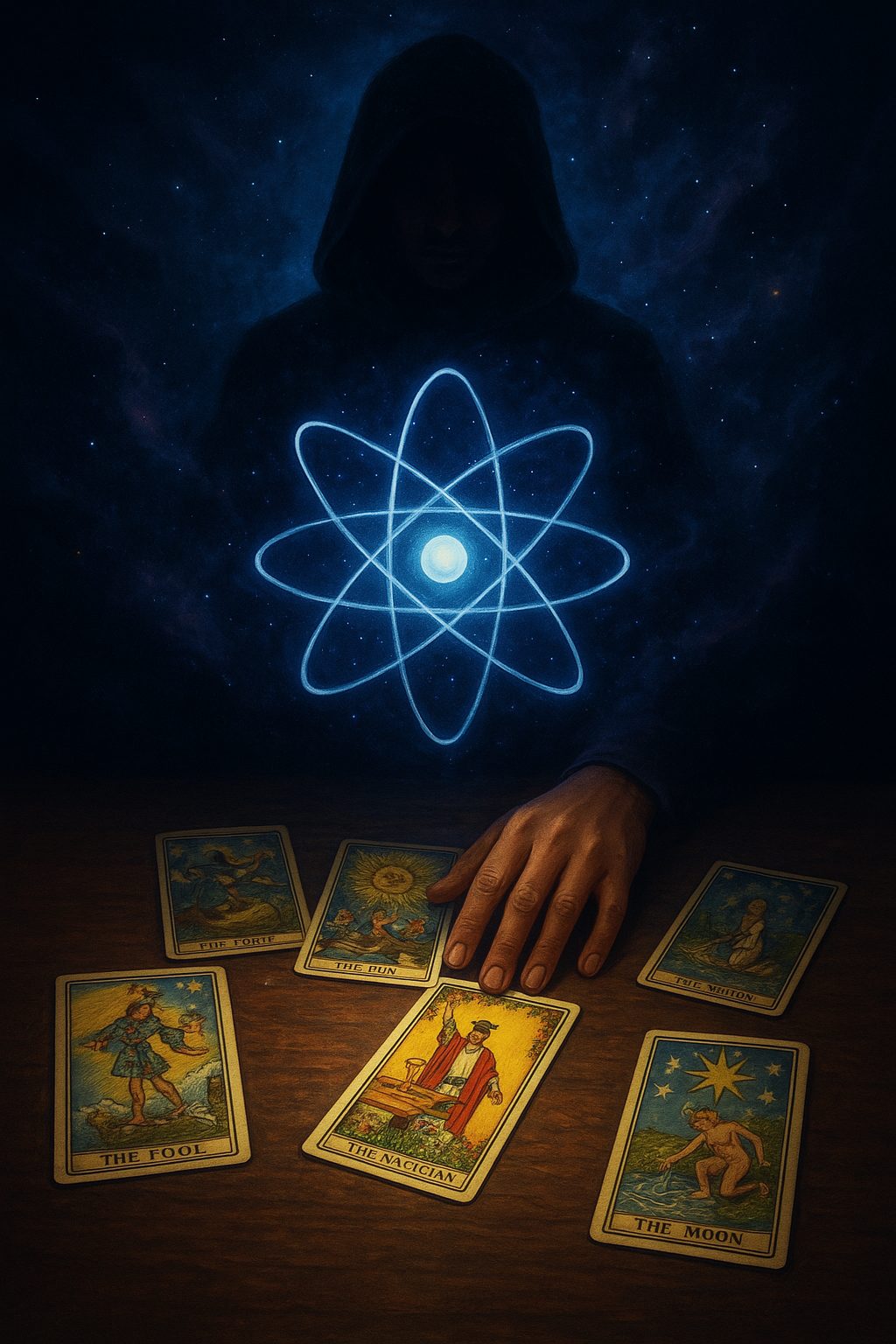
You’ve probably heard the stories: someone gets a tarot reading that describes their exact situation with uncanny precision, or cards reveal a future event that later unfolds exactly as predicted. Maybe you’ve experienced it yourself—sitting across from a reader who’s never met you before, yet somehow knows about your relationship troubles, career concerns, or family dynamics with startling accuracy.
For decades, skeptics have dismissed such experiences as coincidence, cold reading, or wishful thinking. But emerging research in consciousness studies and quantum physics is revealing that there might be actual scientific mechanisms at work that explain why tarot readings can be so remarkably accurate.Let’s start with something scientists have recently discovered about the human brain. It turns out that your consciousness doesn’t just stay locked inside your skull—it’s constantly picking up information from the environment in ways we’re only beginning to understand.Think of your brain like a radio that can tune into different frequencies. Most of the time, you’re tuned to the “everyday reality” station—focused on work, conversations, traffic, and immediate concerns. But just like a radio can pick up faint signals from distant stations, your brain can detect subtle information patterns that your conscious mind normally filters out.During a tarot reading, something interesting happens. The ritual of shuffling cards, focusing on a question, and entering a reflective state acts like adjusting your brain’s antenna. Suddenly, you’re picking up signals that were always there but previously ignored—patterns, connections, and insights that your unconscious mind has been processing all along.
Here’s where tarot gets really clever. The cards don’t work by magic—they work by speaking the same language your unconscious mind uses: symbols and images.Your brain is constantly making connections and seeing patterns, even when you’re not aware of it. It’s like having a super-computer running in the background, analyzing your relationships, predicting likely outcomes based on current behaviors, and picking up on subtle cues from people around you. But this background processing usually stays unconscious.Tarot cards act like a translation device, converting your unconscious insights into visual symbols that your conscious mind can understand. When you see the Three of Swords (traditionally associated with heartbreak), your brain doesn’t just see a pretty picture—it accesses all the emotional and situational data it’s been collecting about your relationships and presents it in a form you can recognize and work with.
The Quantum Connection
Now here’s where things get really interesting. Cutting-edge physics has discovered that everything in the universe is connected through invisible energy fields. At the quantum level, particles can instantly affect each other across vast distances—a phenomenon Einstein called “spooky action at a distance.”While we don’t fully understand how it works, growing evidence suggests that human consciousness can tap into these quantum information fields. Think of it like this: imagine there’s an invisible internet that contains information about everyone and everything, and your brain has the ability to access it under certain conditions.When you sit down for a tarot reading with genuine intention and focus, you’re essentially logging into this cosmic database. The random shuffling of cards becomes a way of downloading relevant information and displaying it in symbolic form. It’s not that the cards themselves are magical—they’re just the interface that allows you to access information that was already available.
Humans are incredible pattern-recognition machines. Your brain can spot connections and trends that you’re not even consciously aware of. You might “just know” that your friend’s new relationship won’t work out, or sense that changes are coming at your job, long before obvious signs appear.Tarot readings amplify this natural ability. When cards are laid out in a spread, your brain goes into overdrive, connecting the symbols to patterns it’s already detected in your life. The Ten of Pentacles might represent family stability, but when it appears next to the Tower (sudden change), your unconscious mind connects this to subtle tensions you’ve noticed at family gatherings but haven’t fully acknowledged.
The accuracy comes from the fact that your brain has already done the analytical work—the cards just help you access and organize those insights.Here’s another factor that contributes to tarot’s accuracy: readings can actually help create the outcomes they predict. This isn’t mystical thinking—it’s well-documented psychology.When you receive a reading that resonates with your situation, it clarifies your thoughts and motivates specific actions. If the cards suggest that taking initiative in your career will lead to success, you’re more likely to speak up in meetings, apply for new positions, or network more actively. These actions then increase the probability of the predicted positive outcome actually occurring.It’s like having a wise friend who helps you see your situation clearly and encourages you to make empowering choices. The “prediction” becomes accurate partly because the reading itself influenced your behavior in ways that made it more likely to come true.
Tarot readings tend to be most accurate when people seek them during times of uncertainty, transition, or emotional intensity. This isn’t coincidence—it’s when your intuitive faculties are naturally heightened.During stressful or pivotal moments, your brain’s pattern-recognition systems work overtime, processing more information and making more connections. You become more sensitive to subtle cues and more open to insights. It’s similar to how people often report having prophetic dreams during major life changes—your unconscious mind is working harder to help you navigate uncertainty.
The emotional charge of your situation also creates what scientists call “salience”—certain information becomes more prominent and easier to access. When you’re worried about a relationship, for instance, your brain is already hyper-focused on gathering and analyzing relationship-related information. The tarot reading simply helps organize and present what your mind has already been working on.
Experienced tarot readers aren’t just card interpreters—they’re skilled at reading people and picking up subtle cues. A good reader notices your body language, listens to the tone of your voice, observes what you wear and how you carry yourself. They’re trained to spot patterns and make connections that others might miss.But there’s more to it than cold reading techniques. Many readers report entering an altered state of consciousness during sessions, where they become unusually perceptive and insightful. They describe feeling like they’re accessing information that goes beyond what they could normally know.
From a scientific perspective, this might be explained by something called “thin boundary syndrome”—some people are naturally more sensitive to subtle environmental information and more capable of accessing unconscious insights. These individuals often become excellent astrologers, counsellors, therapists, and yes, tarot readers.
– Sujoy Sikder
The author is a Vedic/Nadi Astrologer

