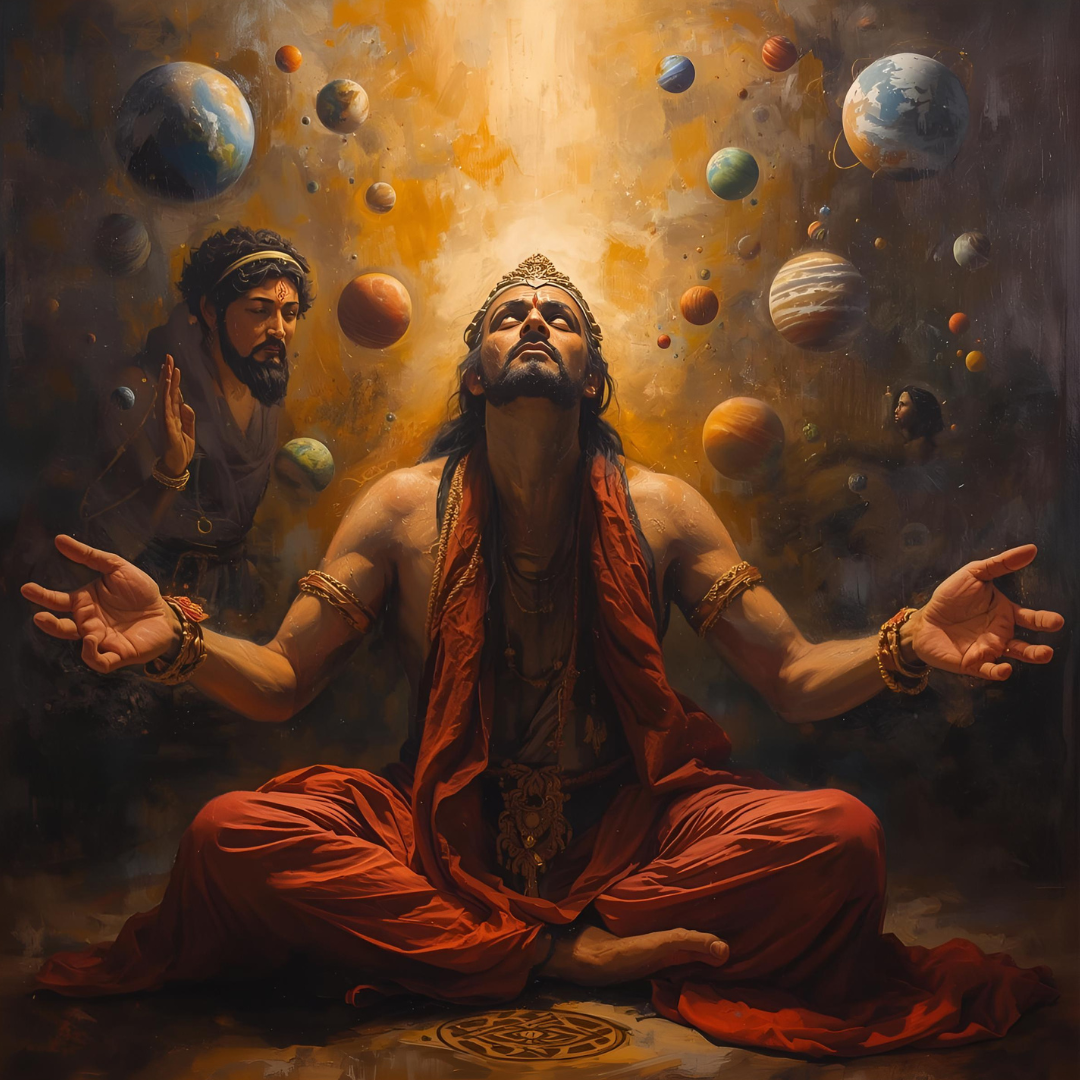
In the shadowed corners of traditional astrological practice, where academic theory gives way to direct mystical experience, lies one of the most profound and controversial aspects of authentic Nadi consultation: Graha Avesha—the temporary possession or overshadowing of the astrologer by planetary consciousness itself. This phenomenon, carefully guarded within hereditary lineages and rarely discussed openly, represents the ultimate expression of astrological practice as divine communion rather than mere intellectual interpretation.
When planetary possession occurs, the astrologer temporarily steps aside as the individual personality, allowing the consciousness of Mars, Venus, Jupiter, or other celestial beings to speak directly through their vocal cords, gestures, and very presence. The consultation becomes not a reading about planetary influences, but a direct audience with the planets themselves.
The Western materialist worldview treats planets as inert balls of matter following predictable orbital mechanics. However, the deepest traditions of Vedic astrology recognize planets as “Chaitanya Rupa Grahas”—conscious beings of immense intelligence and spiritual power who govern specific aspects of cosmic law and human experience.
The Brihat Parashara Hora Shastra declares: “Grahas are not mere celestial bodies, but divine intelligences (Devatas) who have taken astronomical forms to regulate cosmic order and guide human evolution.”
This understanding forms the theological foundation for planetary possession:
- Each planet embodies a specific type of cosmic consciousness.
- These consciousnesses can temporarily inhabit prepared human vessels.
- The purpose is always divine service and spiritual guidance.
- The experience transforms both astrologer and client.
The Brihat Parashara Hora Shastra declares: “Grahas are not mere celestial bodies, but divine intelligences (Devatas) who have taken astronomical forms to regulate cosmic order and guide human evolution.”
This understanding forms the theological foundation for planetary possession:
- Each planet embodies a specific type of cosmic consciousness
- These consciousnesses can temporarily inhabit prepared human vessels.
- The purpose is always divine service and spiritual guidance
- The experience transforms both astrologer and client.
The Hierarchy of Planetary Consciousness
Traditional texts describe planets as existing in a hierarchical order of cosmic intelligence:
Solar Hierarchy (Surya Mandala)
- Sun: The supreme cosmic intelligence, rarely possesses directly
- Mars: The divine warrior, enforcer of cosmic justice
- Jupiter: The cosmic guru, bestower of wisdom and guidance
Lunar Hierarchy (Chandra Mandala)
- Moon: The divine mother, healer of emotional wounds
- Mercury: The cosmic messenger, facilitator of communication
- Venus: The divine beloved, teacher of love and beauty
Saturnian Hierarchy (Shani Mandala)
- Saturn: The cosmic judge, deliverer of karmic lessons
- Rahu: The shadow seeker, revealer of hidden desires
- Ketu: The liberator, dissolver of illusion
The Mechanics of Sacred Possession
Pre-requisites for Planetary Overshadowing:-
Not every astrologer can serve as a vessel for planetary consciousness. The tradition recognizes specific requirements:
Spiritual Preparation
- Diksha (initiation) from an authorized guru lineage.
- Daily sadhana (spiritual practice) over many years.
- Mantra siddhi (mastery over planetary mantras).
- Purification of physical, mental, and energetic bodies.
Astrological Qualifications
- Strong planetary positions in the practitioner’s own chart.
- Specific yoga formations that create channels for divine consciousness.
- Devata yoga indicating connection to planetary deities
- Favorable transit periods when possession is possible.
Ethical Foundation
- Seva Bhava (service attitude) rather than ego gratification.
- Vairagya (detachment) from personal desires and fears.
- Karuna (compassion) for all beings seeking guidance.
- Satya (truthfulness) in all dealings.
The Process of Invocation
Authentic planetary possession follows traditional protocols developed over centuries:
Phase 1: Purification (Shuddhi)
- Physical cleansing: Special baths with planetary herbs.
- Space preparation: Sacred geometry and altar arrangement.
- Mental purification: Meditation and prayer practices.
- Energetic clearing: Pranayama and mantra recitation.
Phase 2: Invocation (Avahana)
- Specific mantras for the planetary deity being invoked.
- Mudras (hand positions) that create energetic receptivity.
- Visualization of the planetary form and consciousness.
- Surrender of personal will to divine intelligence.
Phase 3: Reception (Avesha)
- Gradual overshadowing as planetary consciousness descends.
- Personality dissolution as the astrologer steps aside.
- Divine presence manifesting through voice, gesture, and knowledge.
- Sacred dialogue between planet(graha) and seeker.
Phase 4: Integration (Samapti)
- Gradual withdrawal of planetary consciousness.
- Return of normal personality awareness.
- Integration of received wisdom.
- Thanksgiving and closing ceremonies.
-
- Nadi Astrology has similar several sophisticated methods which varies depending upon various lineages and traditions for direct interaction with the Grahas themselves.
– Sujoy Sikder
The author is a Vedic/Nadi Astrologer